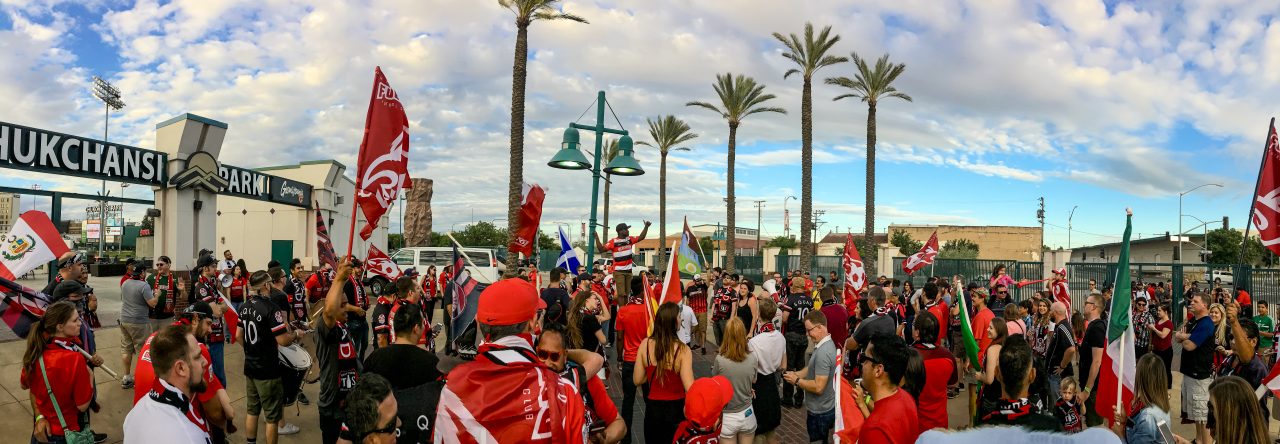
On May 27th, the Fresno City Council is set to hear a plan to build a 7,500 seat soccer stadium in the Selland Arena parking lot. Fuego FC will present the stadium plan as part of a much larger, more comprehensive soccer academy and sports/entertainment project that will include a training and tournament complex near Children’s Hospital Central California in Madera County, an indoor sports center with futsal courts and space for other sports and martial arts in the former Valdez Hall, and a plan to revitalize Selland Arena to host concerts, sports like basketball and hockey, and other entertainment.
According to renderings, the stadium would be sandwiched between Selland Arena / Valdez Hall, the convention center parking garage, the Cosmopolitan Tavern, and O Street, in what is now a surface level parking lot. In order to accommodate a standard FIFA-sized playing field, the stadium would only have seating on three sides, with the parking garage bordering the other. The design will allow Selland Arena to remain standing and appears to allow the Cosmopolitan Tavern tavern to stay in its current location. In addition to being the permanent home of the Fuego FC soccer team, the stadium would be equipped to handle other sporting events such as high school football, as well as concerts and other large scale events.
The academy in Madera County will include 9 fields
Fuego FC has been busy behind the scenes since news broke about the resurrection of the team late last year. In addition to finalizing plans for the downtown Fresno stadium and indoor sports venues, as well as the soccer academy in Madera County, the organization has also laid the groundwork for numerous community partnerships and programs, most of which will benefit Central Valley youth. Examples of those partnerships include discounted tickets, entry fees, and scholarships for youth athletes from southern/eastern/western Fresno, the ability to host CIF sports championships, paid internships for local high school students, and employment opportunities for residents of southern Fresno. Fuego FC also intends to create a 501(c)3 foundation to help give back to the local community.
This story will be updated as more information becomes available.
On December 16th, Southwest Airlines officially announced that it will begin serving Fresno Yosemite Int’l Airport starting in the spring of 2021. Many Valley residents were delighted with the news: Southwest Airlines has been one of the most wished-for national companies among Fresnans (possibly rivaled only by Ikea). While Southwest confirmed that it will begin flying to Fresno (as well as Santa Barbara), the airline did not say where it would fly, how many flights it would initially offer, or exactly when it would begin service. This has led to a lot of speculation, so now seems like a good time to explore the possible destinations that Southwest Airlines will serve from Fresno.
Courtesy of Southwest Airlines
What The First Southwest Flights Will Look Like
The only detail that Southwest gave about its new service to Fresno is that it will begin in “the second quarter of 2021.” It’s fairly likely that the first flights will start in late May or early June; this will give Southwest time to ramp-up service before the summer travel season, which is usually the busiest time of the year for airlines (but could be muted this year because of the COVID-19 pandemic). It’s also fairly likely that Southwest will initially offer 5-8 flights per day from Fresno. Southwest began service to Palm Springs with 5 flights per day, and is beginning service in Jackson, MS with 6 flights per day; Fresno would likely follow a similar pattern. It’s also likely that Southwest will offer more than one destination from Fresno in its initial offerings; Southwest serves multiple destinations from nearly all of the airports it has a presence at. So, let’s take a look at possible destinations Southwest will serve when it begins flying to Fresno in mid-2021.
Destination Airport
Odds Of Serving Initially
Probable Flights Per Day
1. Las Vegas (LAS)
5:1
2-3
2. Denver (DEN)
3:1
1-2
3. Phoenix (PHX)
2:1
1-2
4. San Diego (SAN)
3:2
1-2
5. Oakland (OAK)
1:1
1-2
6. Los Angeles (LAX)
1:2
1-2
7. Honolulu (HNL)
1:3
1
8. Houston (HOU)
1:4
1
9. Chicago (MDW)
1:5
1
1. Las Vegas (LAS)
Las Vegas is the most likely destination for Southwest from Fresno. The most compelling reason for this is the history of strong demand between Fresno and Las Vegas. For most of the late 2000’s, three airlines flew between Fresno and Vegas, including SkyWest (United Express), America West (US Airways), and Allegiant Air. An average of around 100,000 passengers per year flew between Fresno and Vegas in the years leading up to 2011, when US Airways pulled almost all of its non-hub flying out of Las Vegas (SkyWest pulled out of the route for the same reasons a couple of years later). Allegiant Air, an ultra low-cost carrier, has had a monopoly on the Fresno to Vegas route ever since. While demand has remained strong, only about 72,000 passengers flew from Fresno to Vegas in 2019, meaning there is likely room for another carrier on the route. Based on the continued strong demand to Vegas, the continued overall growth of passengers at FAT, and the reluctance of some Fresnans to deal with Allegiant’s “ultra low cost” business model, it’s likely that Southwest will do very well with Vegas-bound travelers from Fresno.
Another reason why Las Vegas is such a likely candidate for service from Fresno is the abundance of connecting opportunities there. Southwest offers non-stop flights to 55 destinations from Las Vegas, making it one of the airline’s largest hubs. Las Vegas is close enough to Fresno that it makes sense for both onward (eastbound) connections, as well as connections to some West Coast cities, such as Reno, Seattle, and Portland. Considering the large demand for travel to Las Vegas from Fresno, the proximity of the two airports, and the diversity of connecting options at LAS, it would be extremely surprising not to see Las Vegas as one of the first destinations that Southwest offers from Fresno.
Courtesy of Southwest Airlines
2. Denver (DEN)
If Denver were any closer to Fresno, it would probably be the most likely initial destination for Southwest. Denver has grown steadily to become Southwest’s largest hub in the western half of the United States, serving nearly 20 more non-stop destinations than Las Vegas. Notable among the non-stop destinations Southwest offers from Denver that it doesn’t from Las Vegas are New York LaGuardia (LGA), Washington Dulles (IAD), Philadelphia (PHL), and Boston (BOS). Denver also has very strong demand from Fresno as a final destination, finishing 2019 as the fourth most popular non-stop domestic city.
Denver finishes second to Las Vegas for a couple of reasons. The first is that it’s much further away than Vegas, making some of the connecting destinations it offers not practical for passengers arriving from Fresno (hardly anyone is going to fly to Denver to then connect back to San Diego, Oakland, LA, or Portland, for example). The second is that Southwest has shown that it prefers to begin serving new airports with shorter routes, and Las Vegas is less than half the distance from Fresno that Denver is. Still, it would be very surprising not to see at least one daily flight from Fresno to Denver as part of Southwest’s initial offerings to give Fresno access to all of the connecting options that are available there.
3. Phoenix (PHX)
Phoenix is another popular final destination from Fresno and another large hub for Southwest. American Airlines been slowly been upguaging its flights from Fresno to Phoenix, and future schedules show multiple mainline flights per day from FAT to PHX in 2021. Allegiant tried flying to a secondary airport in Phoenix in the mid-2010’s, and while those flights were not successful, they did show that the Phoenix region is a popular final destination for Fresnans. While Southwest’s PHX hub offers fewer destinations than Denver, it’s also closer than DEN, and it has some connecting opportunities that Vegas does not. The one thing working against Phoenix is that it would not really add much in the way of connecting options to Fresno if Southwest chose to serve both Las Vegas and Denver. Because of that, Phoenix is not a lock for being in Southwest’s initial offering from Fresno, but its status as a large hub and popular destination from Fresno still puts it solidly at #3.
4. San Diego (SAN)
San Diego has been an extremely popular destination from Fresno since Alaska Airlines began non-stop service, and Southwest might try to steal some of the nearly 100% market share that the Seattle-based airline enjoys on the route. Alaska has been steadily growing its FAT-SAN route, and will offer four flights per day in the summer of 2021. While Southwest does not have an especially large number of connecting options in San Diego, it does fly from SAN non-stop to two popular vacation destinations for Fresnans: Honolulu and Los Cabos. Presumably, Southwest could offer a one-stop option to one or both of those vacation destinations from Fresno through San Diego, and capture many passengers bound just for San Diego at the same time. Like Phoenix, San Diego is not a slam dunk for Southwest from Fresno, but it is certainly high up on the list of options.
5. Oakland (OAK)
As mentioned earlier, Southwest is likely to choose destinations that are relatively close to Fresno for its initial offerings. Because of this, it’s quite possible that Southwest will decide to offer flights from Fresno to Oakland. Oakland is a large focus city for Southwest, but it also does not offer nearly as many non-stop destinations as Las Vegas, Denver, or Phoenix. Additionally, Oakland does not have an especially large amount of demand for “O&D” travel from Fresno (meaning that very few people would only fly only to Oakland – many people would rather drive to the Bay Area than fly).
What Oakland does offer, however, are numerous connections to Hawaii and the Pacific Northwest, two areas that are difficult to get to through Denver, Phoenix, or Vegas. Southwest has shown that it will operate routes based almost solely on connecting traffic (the airline flies from Colorado Springs to Denver – a flight that can take as little as 15 minutes and is about as long of a trip as Fresno to Modesto), so it would not be surprising to see Oakland among Southwest’s initial destinations from FAT.
6. Los Angeles (LAX)
Los Angeles is on this list for some of the same reasons that Oakland is: it’s relatively close to Fresno, and it’s a focus city for Southwest. There is slightly more demand for travel to Southern California as a final (O&D) destination from Fresno than there is to the Bay Area, and two airlines have added new service from Fresno to Los Angeles in the past year. However, Southwest does not currently offer flights from Los Angles to Hawaii, and LAX is further from the Pacific Northwest than OAK is, meaning LAX does not add a lot of connecting options over the airports listed above it. All of this together makes Los Angeles slightly less likely than Oakland.
Courtesy of Southwest Airlines
7. Honolulu (HNL)
Some people will be surprised to see Honolulu on the list of possible Southwest offerings from Fresno, and while there’s definitely not an especially large chance of Hawaii being part Southwest’s initial offerings from FAT, it still merits a spot on this list. Southwest flights from Fresno to Honolulu would not be the first ever service to Hawaii from Fresno; there were actually non-stop flights to HNL from FAT back in the early 2010’s. While that service did not last long, it ended because Allegiant pulled out of the Hawaiian Islands completely, not because flights to Fresno did poorly (in fact, the load factors to Honolulu from Fresno were reported to be above 95%). Hawaii is a popular destination from Fresno, and non-stop flights will capture a lot of travelers who would normally drive to the Bay Area to fly there. Also, Southwest offers intra-island flights from Honolulu (meaning you can connect to Lihue, Kona, Hilo, or Kahului), so flights to Honolulu would also be able to carry connecting passengers bound for other islands. While it would still be a bit surprising to see HNL initially from Fresno, it would not be completely out of left field, and flights across the pacific could be in the cards for Southwest during the next five years if initial service does well.
8. Houston (HOU)
Houston (Hobby) has an outside chance of being in Southwest’s initial offerings for a couple of reasons. The biggest is that there are a lot of passengers who travel from Fresno to the Houston region every day, but currently no non-stop flights between the two cities. Demand to Houston is big enough for FAT to offer an incentive program that waives landing fees and provides cash assistance for marketing to airlines that offer new flights to Houston (and a few other cities). Southwest would qualify for these incentives should they choose to offer flights to Houston, which might be enough to convince them. Additionally, Houston is one of Southwest’s largest hubs, and service to HOU would add numerous connecting opportunities in the Southeastern US and Caribbean that are not available from airports like Denver and Las Vegas. Even considering both of these reasons, it’s still fairly unlikely Southwest would choose to offer flights to HOU, at least initially.
Courtesy of Southwest Airlines
9. Chicago (MDW)
Chicago (Midway) rounds out the list of possible options for Southwest Airline’s initial offerings from Fresno. Chicago would probably be higher on this list if United did not already offer non-stop service from Fresno to the other (and much larger) airport in Chicago: O’Hare. However, Midway is arguably Southwest’s largest and most important hub, and there is a lot of demand from Fresno to the Chicago area. Southwest would also be able to take advantage of FAT’s incentive program if it decided to serve Chicago. However, it’s probable that Southwest would only choose one airport between MDW and HOU for its initial offering (if it chooses one of them at all, which is not very likely), and it would probably pick the route it would have a monopoly on: Houston. Still, we can’t count out Chicago entirely.
Planned Terminal Expansion at The Fresno Yosemite Int’l Airport, Showing 1. Expanded TSA Checkpoint, 4. New Gate Space, 5. New Customs and Immigration Facilities, and 2. 3. 6. New Baggage And Ticketing Facilities
Odds And Ends
The Fresno Yosemite Int’l Airport will be extremely squeezed for space with the arrival of Southwest Airlines. FAT has grown by leaps and bounds over the past decade, and the airport is recovering quickly from the massive drop in travel related to COVID-19. There are currently only seven jetways at the airport, and all are being used by other airlines (multiple ground-level gates are also being used). Airport management will almost certainly need to squeeze Southwest’s flights in (unless another airline pulls out or agrees to use the ground level gates that are still available), but having such a tight schedule could cause any delays to snowball throughout the day and impact multiple airlines.
Luckily, the airport is embarking on a massive new expansion project that will add two new jetways and – more importantly – a proper international arrivals facility to process the multiple flights that arrive every night from Mexico (the current customs facility has been in a “temporary” trailer-like building for over a decade). The new jetways will allow international flights to both arrive and depart at the same gate, freeing up overnight gate space for domestic flights at the existing concourse. Those new jetways can’t come fast enough, and based on the pace at which flights are being added at FAT, it’s possible that the airport will need to start planning for its next round of expansion shortly after the current one finishes.
It’s official! The Fresno area will once again have a pro soccer team, that team will play in its own, soccer-specific stadium (anticipated to open in time for its first season in 2022!), and it will be called “Fuego FC.” As astonishing as that news is all by itself, the new team and stadium are just two components of a much grander vision that’s the brainchild of a local entrepreneur who immigrated to the US from Mexico, attended Dinuba High and Fresno State, and developed several successful local businesses. That man, Juan Ruelas, and his wife, Alicia, are setting out to develop a pipeline through which young Valley soccer talent will be able to progress all the way from youth soccer to the United Soccer Leagues, and perhaps even beyond, without ever needing to leave the Fresno area. There’s a LOT to unpack, so let’s get started.
The Fuego, which started play in 2003, were insanely popular.
The Return Of The Fuego
The loss of professional soccer in 2019 was a devastating blow to the Central Valley’s soccer community. Not only did Fresno FC’s demise bring an end to two years of high-level soccer in the Valley, it also meant the end of the long-standing Fresno Fuego men’s team, as well as the Fresno Freeze women’s team. The Fuego, Fresno FC’s wildly successful predecessor, had been incorporated into Fresno FC’s structure as part of the deal to bring the USL to Fresno. The Foxes’ owner, Ray Beshoff, took the rights to the Fuego with him when he left the Valley. Alas, much of the soccer community will be excited to learn that the Fuego name will be making a comeback.
One of the final Fresno FC matches.
A Grand Vision
The idea that led to the Fuego’s “reboot” actually had its genesis in youth soccer. Geographically, Fresno sits close to the center of California. So, it would stand to reason that the greater Fresno area would be the perfect location to hold state-wide events like youth sports tournaments. However, there are very few regional or statewide youth tournaments that actually take place the Fresno area. Even more frustratingly, talented youth soccer players generally must travel outside of Valley to get the type of training they need to compete at a high level.
Juan Ruelas, like many Valley parents, discovered this problem as his children, who grew up playing soccer, needed to travel long distances to compete in soccer tournaments and to find quality, high-level training facilities. At one point, Ruelas drove one of his children to San Jose twice per week to attend a soccer academy, but that experience gave him an idea.
Sac Republic FC started their own youth academy in 2016 – and made the playoffs that year.
Juan and Alicia knew that the Central Valley had (and still has) a giant pool of talented young soccer players. What if, he reasoned, there was a top-tier soccer academy located in a Central Valley, so that youth didn’t need to travel 2-3 hours by car to attend one (or, even worse, forego attending one entirely)? And, what if that academy was co-located with facilities that had the ability to host statewide tournaments, capitalizing on Fresno’s central location? Thus, Juan and Alicia began forming a vision for a sort of soccer player’s fantasyland, one with acres of regulation sized soccer fields, multiple futsal courts, an indoor field, and an academy that would rival the best in the state.
However, their vision did not stop there. Ultimately, the two wanted to provide Central Valley youth with a pipeline through which they could progress all the way from their very first soccer team to the USL and even MLS. In order to do that, they wanted to make sure that there was a professional team located in the Fresno area. Initially, they planned to partner with Fresno FC, but after things didn’t work out and Fresno FC ultimately left, Juan got in touch with some of Fresno FC’s former staff, including Chris Wilson, the former VP of Operations for the Foxes, who I sat down with last week to discuss the project. Ultimately, they were able to work out a deal with the USL to re-acquire the Fuego name and the rights to the Fresno area for USL soccer.
Infrastructure, Infrastructure, Infrastructure
After years of searching around the Fresno area, Juan and Alicia settled on a plot of land that’s located in Madera County near Children’s Hospital Central California. The location is close to the 41 freeway, making it only about a 5 minutes’ drive from Riverpark (where many area hotels are located) and 15 minutes from downtown. It’s also less than 10 minutes east of the 99 freeway (side note: hopefully this project will be the catalyst that finally gets Madera County to sign off on improving Avenue 9, which is a narrow country road that can be almost as busy as Herndon Avenue at times).
The proposed soccer park location: just north of the river in Madera County.
After purchasing the land and having it zoned for the soccer park and academy, they began drawing up their plans. Much of the legwork has already been completed, and Fuego FC is currently in the process of obtaining the final necessary permits and completing the remaining environmental studies. They anticipate breaking ground on the fields and academy next year.
An aerial view of the site, along with the proposed field and academy orientation.
The most exciting part of the project for Valley soccer fans – the new soccer stadium – is also slated to break ground in 2021. While exact details for the stadium have yet to be finalized, Wilson did share some general information about the venue. He emphasized that nearly every aspect of the stadium is being designed with fans in mind and as a direct result of fan feedback. Most of the stadium’s approximately 5,000 seats will be located along one of the two sidelines, with standard “flip-up” stadium seating on one side, and bleachers on the other. “We wanted to provide an affordable option” said Wilson of the bleacher seats.
Supporter group seating will be behind the goals, and will be able to accommodate all four of the current groups. There will be a few premium suites with associated VIP amenities too. Wilson also hinted about partnerships with local breweries, pubs, and restaurants, both as concession options, as well as potential locations for pre- and post- match festivities.
An example of what the new stadium could initially look like.
Late last week, news leaked that the Fuego and the City of Fresno were in negotiations for part of the Fresno Convention Center complex. According to its agenda, the city council is set to declare Selland Arena, Valdez Hall (the old “exhibit hall”), and the associated surface level parking lot as “surplus properties” during this week’s meeting. That would presumably clear the way for the Fuego to bid on the property.
However, there’s been no indications that a deal is anywhere near finalized, and quite a few hurdles need to be cleared for Fuego FC to even acquire the land, should they ultimately choose to. There’s also no evidence that Selland Arena needs to be torn down to make way for a stadium (side note: both the Fresno Monsters hockey team and Fresno Fire basketball team have expressed interest in playing at least some of their games in Selland). As some might recall, Fresno FC attempted to build their stadium on that same piece of land, but ran into problems related to the Cosmopolitan’s parking lot. The Cosmopolitan is still open, so it’s unclear how that problem would be resolved. It does, however, appear that the City of Fresno is significantly more enthusiastic this time around about keeping soccer downtown.
An overview of the convention center, with an example soccer field (green) and seating area (red) shown to scale.
Another possible option for the stadium would be building it in Madera County alongside the rest of the soccer academy facilities. Stay tuned for more information about the stadium’s location in the coming weeks and months as plans are finalized.
USL League One
The Central Valley Fuego, as the team will be known, will begin play in USL League One in 2022. League One is the third league of soccer in the United States, below MLS and USL Championship, but still fully professional. Fans of the original Fuego will likely recognize at least one team – FC Tucson – which also used to be in the “PDL” league and regularly faced the Fuego. It is likely that Tucson will (at least initially) be Fresno’s main rival in USL One, although there are rumors of other potential new California teams as well.
League One is partially known for its funny promotions.
Other teams in League One include Madison, a franchise that’s well known across the US soccer pyramid for their flashy social media presence and off the wall but popular promotions (ranging from a “pool party night” where they gave away hard seltzer and inflatable flamingos; to a “bro pack” that included a tank top, aviator sunglasses, and a can of natural light; to a Vatican-style release of “pink smoke” when they chose a new head coach), as well as Omaha, Richmond (Virginia), and Ft Lauderdale. “We’re going to be traveling more than some NFL teams” said Wilson of the spread-out league…aside from Fresno and Tucson, every other team is east of the Rockies.
A map showing current and future USL League One teams.
A Lofty Vision
From all appearances, the new Fuego FC organization (which will officially be named the “Central Valley Fuego Fútbol Club”) are making all the right moves to ensure the long-term success of their soccer academy and their team. Already, their front office has organized multiple behind-the-scenes focus groups comprised of former Fresno Fuego and Fresno FC employees and organizers, supporter group leaders, and other Valley soccer enthusiasts. They’ve taken what they have learned from those interactions and their own experiences (remember, many of the people behind the new Fuego team had a hand in the original Fuego and/or the Foxes), and put together what they believe is a winning formula:
Fuego FC will be a continuation of the original Fresno Fuego, a popular and successful brand that still has major appeal around the Valley.
The organization will be “unapologetically bilingual,” with English and Spanish equally represented and interwoven together.
The organization will build a presence throughout the Valley, not just in the Fresno area. This will include everything from running clinics and player appearances, to offering academy scholarships and free tickets, to helping fund the construction of facilities like futsal courts.
Perhaps most importantly, their process will be designed to take youth soccer players, give them a pipeline through which they can progress and grow their talents, and then use that pipeline to fill the Fuego’s roster. Eventually, the goal is for the majority of the Fuego’s professional players to be from the Valley.
Incorporating the above components, Juan and Alicia Ruelas (and the rest of the organization) came up with a five-year plan comprised of four major goals that they believe are 100% attainable:
To have the best team in USL League One, with multiple local players on the roster.
To have a soccer academy that is recognized and competes on a national level.
To bring back a USL League Two team (formerly the PDL) as another stepping stone to the Fuego.
To bring back a women’s team.
Eventually, Juan and Alicia would like to bring USL Championship back to Fresno, and they believe that such a goal is attainable with enough fan support. “We need people to come to games,” said Wilson about the possibility of anything beyond USL League One. The Foxes averaged just over 4,100 fans per game in 2019, an attendance number that would have made them second among all USL League One teams, but put them just below half of their fellow Championship teams. In order to make advancing beyond League One practical, that number would likely need to grow.
Fresno FC had multiple matches that drew above 7,000 fans, and some that drew less than 3,000.
However, with enough support, anything is possible. While still a decade or more away, Ruelas is hopeful that his vision will help lay the groundwork for the Fresno area to one day be in the running for an MLS team, and he thinks such an opportunity could come along with enough support and should the region’s population grow fast enough.
Wrapping It All Up
One can’t help but be impressed with everything that the Ruelas family is doing to bring a first-rate youth soccer academy and professional soccer team and stadium to the Central Valley. Every aspect of the project, from the soccer complex and stadium to the team itself, is being 100% privately financed, mostly by he and his wife, with no public money going towards the academy or stadium.
While the Ruelas family and Fuego FC are not asking for a single penny of public funding, they ARE asking the Valley for its support. That’s where everyone reading this article comes in. After news about the convention center land broke last week, I read dozens of comments online showing support for the new Fuego team, many asking “what can I do to help?” To that I say: buy tickets (you can already put down a deposit on season tickets) and merchandise, bring your friends and family, share your passion for soccer and for the Fuego with others, join a supporter group, get your kids involved in the academy, and, in general, show the world that the Valley is 100% behind this project.
Fuego FC supporter groups are already on board with the new team.
After a year without a local team to root for, the Valley’s supporter groups are definitely ready to get behind the Fuego. “Fire Squad is extremely excited about the announcement of the Fuego, the connection to the history of football in our area and the development of this franchise for all the valley, from youth to professional level. We can’t wait to join together as supporters and root for a team that truly represents us all. Dale Fuego!” said Ed Stewart, head of Fire Squad Fresno. Another member’s comment, while simple, may have put it best: “let’s gooooooooo!”
Since the news broke about the Foxes potentially leaving Fresno, there’s been a flurry of activity from supporters, fans, and residents of the Valley to show our support for keeping Fresno FC in the Valley. I’ve summarized everything that’s happening in the following weeks so YOU can get involved with the “Stay in Fresno” movement and let the City of Fresno, the USL, and Fresno FC ownership know that we want to keep the Zorros in Fresno! This page will be updated as more events and details are added.
Next Saturday, the 12th, the Fresno Foxes will take on LA Galaxy II at Chukchansi Park. Members of the Vigilantes supporters group recently started a Go Fund Me to purchase 4,000 “Stay In Fresno” signs for that match, reaching their initial goal in just a few hours (you can still donate until Sunday night). The first 4,000 fans at Saturday’s match will receive “Stay in Fresno” signs, and everyone who donates will get a “Stay in Fresno” shirt. Let’s pack the Chuck AND let Fresno FC ownership, the USL, and the City of Fresno all know we want out Foxes to stay in Fresno!
Fresno City Council Meeting
Sometime last week, the Fresno City Council added an item to next Thursday’s agenda:
“CONFERENCE WITH REAL PROPERTY NEGOTIATOR – Government Code Section 54956.8 Property: 1707 W Jensen Ave, Fresno, CA Negotiating Parties: City of Fresno, Fresno Foxes”
We can only assume this is a last-ditch effort to find a location to build a soccer stadium. While this part of the meeting will be closed to the public, everyone is encouraged to attend the public part of the meeting wearing Foxes gear and showing their support for the team. The meeting starts at 9:00AM on Thursday the 10th at city hall.
Online Petitions and Letters To Edwards and Beshoff
Members of multiple supporters groups have combined to draft petitions to Jake Edwards, the president of the USL, and Ray Beshoff, the owner of Fresno FC. Everyone is encouraged to sign these petitions. In addition, we are encouraging all fans to write a personal note to both Mr Edwards and Mr Beshoff. You can either add your own personal touch to the letters we have already written, or you can write your own from scratch.
Contact Info To Write To Mr Edwards and Mr Beshoff and Sample Letters
Email Address for Mr Edwards: jake.edwards@uslsoccer.com
Email Address for Mr Beshoff: rbeshoff@fresnofc.com
Letter to Jake Edwards:
Dear Mr. Edwards,
A little more than two years ago, you stood in the concourse at Chukchansi Park in Downtown Fresno and helped us welcome a brand new USL franchise to our great city. Soccer fans all over the Central Valley were overjoyed knowing that we were joining one of the fastest-growing, premier soccer leagues in the world. In the two years since that announcement, our city has embraced the new team, and many residents have become steadfast, highly loyal fans. While our ticket sales might not have matched some of the most successful clubs in the USL like New Mexico, Indianapolis, and Cincinnati, we have still produced a respectable attendance for a second-year team in our league and for a city of our size.
Many of Fresno FC’s fans are highly invested in the team, and we have fans that regularly travel from as far away as Minnesota and Japan to watch the Foxes play. The team has become an extremely important part in the lives of many Valley residents. It has inspired three fans to create the Fox Trot Podcast, which captures their love for the team, the city the Foxes call home, and the USL Western Conference. It has helped one of those podcasters through the loss of a father and the loneliness of separation and depression.
The team has also become an important inspiration to our younger fans, and many of Fresno FC’s players have become role models for the Valley’s soccer youth. These younger soccer fans, many of whom aspire to also be on a professional team one day, look forward to watching their favorite players on the pitch at every match. Most of these youth were heartbroken when they learned that there might not be a team to root for at all next season. Mr. Edwards, we know you are a businessperson, but we also ask you to consider all the lives that will be negatively impacted by moving Fresno FC to another market.
We also understand that the team’s financial numbers have not been exactly what Mr. Beshoff had hoped they would be. Even more importantly, we know that the ownership group has had a difficult time building a stadium, and that the City of Fresno probably hasn’t been as helpful as they could have been in finding a location for it. However, we also ask you to look at the short time frame that has transpired since the team was announced and began play, as well as the relatively small amount of marketing that has occurred in the last two seasons, and ask yourself, “is granting permission for a move really a fair course of action, as well as a smart precedent to set for other ownership groups?” We also ask you to look at the plan to move the team, and ask yourself, “will moving the team to a significantly smaller market really produce better a result?”
We, as Fresno FC fans, are willing to help the USL and the franchise ownership in any way we can that will keep the team in Fresno. We have already drafted letters to the mayor of the City of Fresno and to individual council members, letting them know that we expect more action from them. However, most people in Fresno and the Valley feel blindsided by this decision, and we ask you to offer us more time to get a proper stadium location chosen before making a rash decision like allowing the team to move or completely shut down.
Sincerely,
Fresno FC Fans
Letter to Ray Beshoff:
Dear Mr. Beshoff,
A little more than two years ago, you stood in front of community leaders, reporters, and fans in the concourse at Chukchansi Park in Downtown Fresno and introduced a brand new USL franchise to our great city. One part of your speech that day that really meant a lot to us was how much you emphasized your commitment to Fresno and to the Foxes. Soccer fans all over the region were overjoyed knowing that we were finally getting a professional soccer team, led by an owner who was extremely passionate about both soccer and the Central Valley. In the two years since that announcement, our city has embraced Fresno FC, and many residents have become steadfast, highly loyal fans. While our ticket sales might not have matched some of the most successful clubs in the USL like New Mexico, Indianapolis, and Cincinnati, we have still produced a respectable attendance for a second-year team in our league and for a city of our size.
Many of Fresno FC’s fans are highly invested in the team, and we have fans that regularly travel from as far away as Minnesota and Japan to watch the Foxes play. The team has become an extremely important part in the lives of many Valley residents. It has inspired three fans to create the Fox Trot Podcast, which captures their love for the team, the city the Foxes call home, and the USL Western Conference. It has helped one of those podcasters through the loss of a father and the loneliness of separation and depression.
The team has also become an important inspiration to our younger fans, and many of Fresno FC’s players have become role models for the Valley’s soccer youth. These younger soccer fans, many of whom aspire to also be on a professional team one day, look forward to watching their favorite players on the pitch at every match. Most of these youth were heartbroken when they learned that there might not be a team to root for at all next season. Mr. Beshoff, we know you are a businessperson, but we also ask you to consider all the lives that your team has had a positive impact on over the last two years, as well as all those who will be negatively impacted by moving Fresno FC to another market.
We also understand that the team’s financial numbers have not been exactly what you had hoped for at this point. Even more importantly, we know that your ownership group has had a difficult time finding land to build a stadium, and that the City of Fresno probably hasn’t been as helpful as they could have been in helping with the search. However, we also ask you to look at the short time frame that has transpired since the team was announced and began play, as well as the average time it takes a USL club (or any professional team, for that matter) to find a stadium location and to start making money, and to ask yourself, “will moving the team to another location definitely produce a better result and better attendance, and how much work will it take to completely start over from scratch?”
We, as Fresno FC fans, are willing to help you and the rest of the ownership group in any way we can to help keep the team in Fresno. Many of us have already drafted letters to the mayor of the City of Fresno and to individual council members, letting them know that we expect more action from them. However, most people in Fresno and the Valley feel completely blindsided by this decision. So, instead of abandoning this project that you have already spent so much time, effort, and money on, we ask you instead to join our campaign to find a proper stadium location before making a rash decision like moving or completely shutting down the team. Most importantly, we ask you to honor the commitment you made to all of us on that summer day two years ago and keep the team in Fresno until we can get a stadium deal worked out.
By now, you’ve probably heard the bad news. If you haven’t, allow me to break it to you: Fresno FC, the Central Valley’s only professional soccer team, will probably not be playing in Fresno next season. They might simply take a hiatus, or they might move to another city outside of the Valley. This news broke on Fox Trot Podcast, and I encourage you all to download their latest episode to get the whole story. For all of us die-hard fans, especially those of us who were in the stands for the Zorro’s hard-earned victory against Phoenix last week, this probably comes as quite a shock. Many fans are probably looking for the “why,” so my aim with this post is to start a conversation about how we got here, as well as what our next move will be. Let’s start in the beginning.
In the beginning…
The Fresno Fuego
Fresno FC didn’t just appear out of nowhere, like many other USL teams in other cities did. It was the product of more than a decade of hard work and organic growth. The seeds of professional soccer in the Valley were planted nearly 17 years ago, when the idea of the Fresno Fuego was conceived in 2002 by a group of extremely passionate Central Valley soccer fans. The brand new team began play at San Joaquin Memorial in 2003 in front of a handful of fans. Over the following decade, the team’s fan base swelled. Soon, they had their very own supporters group, the Fire Squad, and thanks to the hard work of a number of other (also extremely) passionate fans, the Squad’s numbers began to quickly grow. The Fuego were soon drawing (by far) the largest crowd in the PDL, the (then) fourth league of American soccer, and in 2007, they began playing their matches in Chukchansi Park in Downtown Fresno.
Then, around 2016, an investor group led by the owner of a number of car dealerships (including one in Fresno) named Ray Beshoff took notice of the Fuego’s success and decided it was time for Fresno to have its own professional soccer team. In mid-2017, hundreds of soccer fans came to Chukchansi Park to watch Mr. Beshoff announce the new franchise, to put down deposits on season ticket packages, and to celebrate the evolution of soccer in the Valley. Fresno would join the likes of Phoenix, San Antonio, Indianapolis, Pittsburgh, Tampa, and many other major cities as the proud hosts of a USL soccer franchise. Fresno FC was born.
Fresno FC’s First Home Match in 2018
In its first season, Fresno FC averaged a home attendance of just over 4,800 fans per match, good enough for 11th in the USL out of 33 teams. While this number fell short of the top teams in the league, it was still fairly average league-wide, even counting out all of the the “2” teams who (mostly) drew minuscule crowds (a few MLS teams have their own developmental teams, often referred to as “2” teams…these teams don’t really market to fans and often play their matches on practice fields). Everything seemed to be going fine.
The trouble starts…
The first hints of trouble within the Fresno FC organization came at the end of 2018, when the cuts began. After Mr. Beshoff and his investor group started the Fresno FC franchise, The Fresno Fuego were renamed the Fresno FC U-23s, and the Fresno Freeze, the women’s counterpart to the Fuego, were renamed the Fresno FC Ladies. Both of these teams continued to play in 2018 along side Fresno FC, but towards the end of that season, it was announced that both of those amateur teams would begin an indefinite hiatus in 2019. Additionally, there were some major shake-ups in the front office at the end of 2018, with a number of people leaving, some of whom had been with the Fuego organization for years (you can listen to the Fox Trot Podcast for more about this). While some fans were concerned with the cuts and moves, many of us continued to focus on the team.
Fresno FC vs Phoenix Rising in September 2019
The 2019 season began with much excitement, and on the field, the team was winning. However, attendance numbers began to decline, at least on paper. As I write this post, despite having one of the best records in the entire USL, the average home attendance crowd for Fresno FC in 2019 stands at just over 3,800 fans, a decline of nearly 1,000 fans per match from 2018. I use the term “attendance numbers” because it certainly doesn’t feel like there are fewer fans at matches. In an interview with the Fresno Bee in July, the team’s general manager, Frank Yallop, confirmed that paid attendance actually remained about the same in 2019 from 2018, with fewer free tickets being given out this year. From that interview, we can infer that the team is making about the same income from ticket sales in 2019 as it did in 2018.
Despite the decline not being quite as bad as it seemed, the fact remained that the number of tickets being sold every match in 2019 remained flat, and short of what the team needed to break even financially. At the same time, the team continued to have trouble finding a site for a new stadium, and continued to pay extremely high costs to use Chukchansi Park. So, they continued to cut where they could, including front office positions. By the time I publish this, Fresno FC will have the smallest front office staff in the USL.
How did we get here?
So, why is Fresno FC having so many problems? Ask fans (or just residents of Fresno), and you will get dozens of reasons. I definitely think we should explore some of those reasons. However, I also think we should start that exploration by talking about the people and the factors that we shouldn’t blame.
Don’t blame the team!
First and foremost, we shouldn’t blame the players for the team’s stadium and attendance issues. Of course, our Foxes are some of the most talented athletes in the USL…many of them are playing at an MLS level. If you haven’t seen them in person yet, you owe it to yourself to go before they aren’t here anymore. However, what’s really made the Fresno FC team special has been how much they have embraced their fans and the entire Central Valley. I’ve never seen so much positive interaction with fans, at any level in any pro sport, whether in the stadium, around town, or on social media. Again, I could go on for days about how much love each individual player has shown for the Valley and for the Fresno FC fanbase, but sufficient to say, they have been nothing short of amazing. For the players – and all the hard work and passion they have given us – we need to keep going to matches to support them.
Our supporters are awesome!
Passionate Fans
Secondly, we shouldn’t blame the fans or the supporters groups. I’ve been to quite a few soccer matches outside of Fresno, including a few other USL matches. While the crowd at most Fresno FC matches might not be quite as large as in some other cities, the passion, noise, and overall atmosphere in the stadium is just as strong as almost anywhere in the USL, and even approaches the levels found in some MLS stadiums. Fresno fans have also bought loads of team merchandise – the team store often sells out of new products almost immediately. And, many fans have gone much further than simple support, creating their own podcasts and blogs, throwing down big money to travel to away matches, and even getting tattoos about the team. Yes, there might not be enough people in the Valley who know that Fresno FC exists, but those that do have turned out to support the team in a big way.
We don’t want to point fingers, but…
So, who should we blame for the team’s lack of financial success, including the potential hiatus and/or move? First and foremost, if the team’s statements and communications are to be believed, we should probably start with the City of Fresno. While there are not a lot of publicly available details about the dealings between Fresno FC and the City of Fresno, there have been numerous reports about the city’s reluctance to provide help with finding a place to build a soccer-specific stadium. After the city, I think we should blame the ownership group themselves, as well as the United Soccer League. Let’s explore all three of these issues…
Why hasn’t the city hasn’t helped more?
As many of you know, the City of Fresno has had a bad taste in its mouth since getting stuck with the bill for numerous sports-related projects, including Chukchansi Park and Granite Park. Of course, no one expects the city to fully fund a soccer stadium the same way they (basically) fully funded “The Chuck” (although the estimated $10 million price tag for a soccer stadium would be a complete bargain compared to the $65 million price tag of Chukchansi Park in today’s dollars [$45 million in 2002]). And, the ownership group has made it very clear that they are willing to pay the entire $10 million construction costs for a stadium. However, most of the communications, statements, and sound bites from the team about possible stadium locations have either outright stated or strongly alluded to the fact that the city provided very little help with finding land to build that stadium. There have, apparently, been numerous possible locations, including the parking lot next to Selland Arena, land at Granite Park, and a few spots off of 99 near the Island Waterpark. None of these have ended up working out. The lack of a soccer specific stadium is hurting the team’s potential for long-term success in Fresno more than any other factor. While better attendance could have prolonged Fresno FC’s run in Chukchansi Park, the lack of a stadium would have still made that run temporary.
The city’s position is not especially surprising. Current city leadership has been very stingy with sports teams recently, making it extremely clear that they would only make deals with teams if they also benefited the city (or, at least, had zero financial liability for the city). Yes, Mayor Brand will appear in Fresno FC promotional videos all day, but he has made no secret of the fact that he doesn’t want to give up even a dollar of city funds to help any Fresno team with stadium or arena issues. The reluctance to help Fresno FC find a stadium site seems very shortsighted: Fresno FC has been a major contributor to the Downtown Fresno economy (and the overall economy of the Valley). Even with only 4,000ish fans per match, the bars, breweries, and restaurants around the stadium are often full before and after matches. The team contributes in other ways too, including hotel rooms from visiting teams and fans, and airline seats as the Foxes or their competitors travel to and from matches.
Again, no one is expecting the city to completely fund a stadium, just to help the team secure land and maybe kick in a little help for infrastructure. Seeing how they bent over backwards to meet Amazon’s demands, giving up millions in tax dollars, as well as the hundreds of thousands of dollars they give every year to help the new Grizzlies ownership group, it seems like they could have helped the Fresno FC organization just a bit more. The reluctance on the city’s part might have also contributed to the difficulty in finding a buyer for the team. Chris Brown said it best in the Fox Trot Podcast, “we need to vote, we need elect people who are going to keep these things alive.” At the very least, fans of Fresno FC should let their council member and the mayor know about their displeasure with the city’s lack of help finding a stadium site.
Why do we need a stadium, anyway?
As a side note, some might wonder why Fresno FC really needs its own stadium. There are a few reasons. First and foremost, the USL requires all its franchises to have their own soccer stadium, and only allows them to play in other team’s stadiums (like Chukchansi Park) temporarily. Secondly, the Chuck has turned out to be a TERRIBLE place to watch soccer. The sight lines are awful from many seats, and the new netting (which will be expanded next year) makes seeing the action on the pitch even more difficult. Thirdly, the Chuck is just too large for the current crowd…even with recent renovations to make it smaller (by adding amenities), its 10,000+ seats are too much for all but the best-attended USL matches. Lastly, and perhaps most importantly, the Chuck is a very expensive place to play soccer: the field must be converted from baseball to soccer at a cost of tens of thousands of dollars, and the team’s rent and their contacts for things like concession sales are not the best. The team can’t sell naming rights or control advertising. In short, the Chuck is not an ideal place for soccer fans to watch a match, and it is an extremely expensive place for the team to play.
Did they know what they were getting themselves into?
Empty Stands in Austin
After the City of Fresno, I think we should consider blaming the team’s ownership group and their upper-level management for the potential hiatus or move. I say this for two major reasons. The first is that Fresno FC’s current attendance problem is not unique among USL teams. Several other teams, including Reno, RGV, and Tulsa have had similar declines in attendance this year, and all are averaging about the same (or lower) attendance as Fresno FC. Tulsa recently went through a similar predicament to Fresno, but with a new ownership group stepping in and buying the team. Tulsa’s attendance has been abysmal this year compared to Fresno, averaging only around 2,000 fans per match, yet the team keeps playing – in a baseball stadium. Teams from Pittsburgh, Orange County, Austin, Charleston, and Charlotte all have lower attendance than Fresno too (some significantly lower), yet Fresno is apparently the only team that is considering shutting down or moving. UPDATE: Many also blame the ownership group’s misguided assumption that they would make money in the Chuck after just two years, when even the expectation of making money in a soccer specific stadium after two years of play would be optimistic, at best. While the stadium issue is obviously a major factor, the attendance numbers alone do not appear to warrant an extreme measure like a move or shutdown. In short: based on the numbers available from other USL clubs, it appears that Fresno’s attendance problem does not warrant a shutdown by itself, and it feels like the ownership group is giving up way too quickly.
Secondly, it’s become clear that the team hasn’t done enough to market itself in the Valley – and to market itself in the *right way*. Despite playing in Fresno for almost two years, a large portion of the city still has no idea that the team even exists. UPDATE: According to Jordan Wiebe, who was instrumental in forming the Fire Squad and went on to work for Fresno FC, in their first year, the team spent about 50% of what the average USL team spends in marketing…despite the USL recommending spending around 150% of the average to get the team off the ground. That number was presumably cut even further in year two, meaning that the team was barely getting its name out. To confirm that, I went to River Park and polled 28 groups of people, asking each group the same question: “Did you know that Fresno has a professional soccer team?” Of those 28 individuals or groups of people (I only counted each group as one, no matter how many people were in it), only 6 answered “yes” and knew that the team was Fresno FC (one additional person answered “yes, the Fresno Fuego”). Of the remaining groups, most seemed surprised when I told them about Fresno FC, where they played, and how well they were doing. A few people initially thought I was talking about Fresno State, which doesn’t even have a men’s soccer team anymore. Even if you count the person who mentioned the Fuego, just 25% of respondents to my survey actually knew about Fresno FC. While the poll was in no way scientific, and could have been larger (if I had more time), the results still point to the team not effectively marketing themselves to the entire metro area.
(As a side note, we should definitely NOT be blaming the person or people who are responsible for the amazing merchandise and phenomenal videos that the team has been putting out – they are some of the best in the league).
I’m not sure whether the team’s ownership didn’t know what they were getting themselves into in Fresno, whether they thought they could just “buy” the Fuego’s past successes and then ride that trajectory to the bank, or whether they simply tired of Fresno and just gave up on making soccer successful in the Valley. However, it’s fairly clear that they bear at least some of the responsibility for the continued flat ticket sales and for the lack of awareness of the team among Valley residents … so they definitely deserve some of the blame for their own financial problems. I think that Ed Stewart illustrated this point best in the Fox Trot Podcast: “There could be an ownership group built with local connections – with local understanding of the market – that wouldn’t just think that by planting a team here, that people would magically show up. That would spend the money to promote it properly, to reach out and make it very much a team that connects with all parts of the valley.”
UPDATE: What is the USL doing to stop this mess…or are they doing anything?
The USL will not be blameless should the team shut down or move. There was much fanfare on the part of the USL when the team was announced, and the league made a huge show of their commitment to the Fresno market. Now, it appears they are just going to let the team ownership start a hiatus and/or move the team elsewhere. According to sources that have reached out to me since this article was first written and spoke on the condition of anonymity, the USL has even favored the plan to move – keeping the team under the current ownership’s control – over other plans that would have kept the team in Fresno under different ownership. More detail about this will surely come out in the following days and weeks, but the central question will be, “will Fresno join the likes of former NFL franchises in Oakland, St Louis, and San Diego in getting screwed by league management that was supposed to protect their interests, or will the City of Fresno and Fresno FC fans be able to pull out a miracle similar to the Colombus Crew of the MLS when their ownership proposed a (super shady) move to Austin?” Again, this is a place where the City of Fresno can pull its weight…but will it?
So, where do we go from here?
I did really like “Fuego red”…
There might be a light at the end of the tunnel. First of all, this battle isn’t over. There is still a chance that Fresno FC could survive…a buyer could still step in. Hopefully, Fresno’s leadership will read this and at least contemplate doing something to help save the team – but I wouldn’t hold my breath. If the team does move or fold, it seems likely we will see another soccer team in Fresno within the next few years. That team would probably not be a USL “Championship” league (USL C for short) team like Fresno FC currently is. There are a total of three leagues in the USL, including a professional league right below USL C named “USL 1”. Fresno’s attendance would be the second highest of all the current USL 1 teams this year, and far above the average…but most of the teams are in the Midwest, so travel costs would be high. Then there’s “USL 2”, which is basically the same league that the Fuego were in. This move would feel like a huge step backwards, but would also make the most sense right now. UPDATE: Any replacement team could not be called either Fresno FC or the Fresno Fuego, at least not until someone purchases the rights to those teams back from the current ownership group. Until then, we might see “Fresno FC” playing their home games 2 hours to the west of Fresno. The hope would be that a move back to USL 2 would allow the city to get its act together with finding a stadium site – even the USL 2 team wouldn’t want to play in “The Chuck” forever, they would still need their own stadium.
What can you do?
Well, if you just so happen to have a spare $50 million laying around, please buy the team and keep it in Fresno. Otherwise, and I say this with all seriousness, write your councilperson, and write the mayor. Tell them about your displeasure with their lack of help on the stadium issue. Tell them about what you have lost personally, but also tell them about what Downtown Fresno has lost. And, be sure to tell them that you vote, and will remember this when the next election comes around. Also, please continue to support the team. I know many people might want to boycott Fresno FC out of anger, but that will only hurt us in the long run. And, it will only hurt our players, who have given their hearts to the city and to their fans. If we turn out in big numbers in these final weeks, despite the bad news, maybe it will help convince someone else to take a chance on us. Let’s not forget, we are still going to the playoffs…
For decades, there has been talk of attracting large retail stores to springboard development in Downtown Fresno. Starting in the 1990’s and peaking in the 2000’s, city leaders put a major effort into attracting a nationally recognized, “big box” store that would anchor a suburban-style shopping center south of Chukchansi Park. The most memorable of these efforts was the Bass Pro Shops and South Stadium saga (not to be confused with the current, completely different South Stadium project). At that time, civic leaders believed that Bass Pro or Ikea or another “destination” retailer (along with an accompanying shopping district) would be a sort of “silver bullet” in the revitalization of Downtown Fresno.
Fulton Street and the (new) South Stadium block under construction.
Of course, no destination store ever came, and a downtown shopping area never materialized. Many people were disappointed at the time, but today, the general consensus is that it was actually a good thing that a large commercial center was never built downtown. After the first South Stadium project fell apart, Fresno’s civic leaders decided to change tactics and instead began to pursue many smaller, more manageable development projects.
As a result of these efforts (and the efforts of countless members of the downtown and greater Fresno community) over the last few years, the fate of Downtown Fresno has finally started to swing the other way, led mostly by an explosion of jobs and housing in the area. Almost six hundred new apartments have either been completed or are in various stages of construction, with hundreds more still in the planning stages. The number of employers in Downtown Fresno is also on the rise: more than fifty new businesses have been launched downtown in the last three years, and over 150,000 square feet of new office space (mostly tech) was announced in the first quarter of 2017 alone. At the heart of all of this is the rise of millennials and their preference to live and work in urban areas rather than the suburbs that the generations before them gravitated towards.
Enjoying live music, food trucks, and, of course, beer at Tioga Sequoia Brewing Company in Downtown Fresno.
As young people move into downtowns across the country (Fresno isn’t the only place where this transformation is happening), they are bringing with them a need for services and entertainment. In many urban centers, trendy bars and restaurants are moving into downtowns and retailers are retooling their store designs to match millenials’ shopping habits. By the end of 2017, Downtown Fresno will have five microbreweries as well as multiple new coffee shops and restaurants. There are currently three grocery stores downtown (Grocery Outlet, Smart and Final, and Central Fish Company), in addition to a FoodMaxx located in nearby Kerney Palms. Downtown Fresno is growing nicely, but what the area is most lacking is a general merchandise store like a Target.
Current Target and WalMart locations in Fresno.
If you look at a map of the region, Target and Wal-Mart have most of the Fresno/Clovis area pretty well covered. In the southeast, northeast (including Clovis), and northwest, most residents live no more than a couple miles from either of these brands. However, there is a huge, almost gaping hole in the southwestern part of town (including downtown) where no stores of this type are easily accessible. For someone living in the Pacific Southwest building or the new lofts at Van Ness and Inyo, the closest Target or Wal-Mart is more than 5 miles away. For a family living in the southwest part of the city near the Chandler Airport, one of these stores is even further.
Target has been near the top of the “retail wish list” of Downtown Fresno residents for quite some time (even though most downtown residents tend to prefer non-chain stores and restaurants). Until a few years ago, Target only had two types of stores, giant-sized ‘regular’ Targets and even larger-sized Super Targets. Both of these concepts were simply too big for Downtown Fresno, and for many other densely-populated areas around the country. Recognizing a growing need, Target began making plans for a new line of smaller stores designed just for urban areas.
A “CityTarget” sized store in downtown Portland.
Shortly after 2010, realizing that there were many areas across the country that either could not support full-sized Target locations or did not have the room to build them, Target Corp created two smaller formats of stores: “CityTarget” and “Target Express.” The former – a scaled-down (about 2/3 size) version of a regular Target store – opened mostly in larger metropolitan downtowns: New York, Seattle, and San Francisco were three of the first cities to get one. The latter – an even smaller store format (the first few were not much bigger than a standard CVS or Walgreens) – began to pop up in areas surrounding universities and in other urban areas. According to the retailer’s website, Target Express stores were “tailored to city dwellers” and featured “an edited assortment of merchandise, including fresh produce, grab-and-go food and snacks, pharmacy, home, seasonal, electronics, beauty and more.”
A “Target Express” sized store in Downtown Berkeley.
Then, in 2015, Target began to re-brand CityTarget and Target Express stores, calling them simply “Target” ‘flexible-format’ stores. The retail giant’s corporate website described what the change meant for the brand: “In the last three years, we introduced flexible formats called CityTarget and TargetExpress in 14 locations across the country. These stores vary in size and assortment, and allow us to create a more locally-relevant experience for guests in urban areas. We’re committed as ever to our urban growth strategy, developing stores specially designed for densely populated areas. And we’ll keep integrating our digital channels, services like Store Pickup, and other innovations into the experience so guests always have all of Target at their fingertips.”
Housewares at Downtown Berkeley’s Target.
I decided to visit two former Target Express locations – now branded as “Target” stores – in Minneapolis, MN and Berkeley, CA. Both of these stores are fairly small: they clock in at 20,000 square feet or less (again, around the size of a Walgreens or CVS). However, both locations carry a much more appealing and functional assortment of items for urban dwellers than the convenience stores they are partially aiming to compete with. In addition to many of the same items that can be found at a typical CVS (including a full CVS pharmacy – more on that Target/CVS relationship in a bit), I also found:
A large assortment of everyday products, including a good-sized grocery section that had much more than just the chips, candy, and soda that dominate convenience stores.
A housewares section that had everything from basic tableware and cookware to storage containers, bathroom items, and a small assortment of sheets, towels, and pillows.
A fairly good assortment of cleaning supplies and consumable that ranged from zip-lock bags, paper towels, and toilet paper, to bathroom/kitchen cleaners, detergents, and sponges.
A few aisles of personal-care items including shampoo, soap, toothpaste and brushes, cosmetics, and more.
A small clothing section including many basics ranging from underwear, socks, belts, and sleepwear, to a very basic selection of pants, shorts, shirts, and outerwear.
A good-seized electronics area that had a lot of accessories, including headphones, chargers, cables, memory cards, batteries, printer ink, and top-up cards, but also had a small number of cell phones, tablets, and a couple other small electronics.
Additionally, there was a small school/office section, a very small automotive section, and a few locally-branded items.
Patrons can order any item that Target sells and have it shipped to the store. They can also return any item they purchased from any Target.
Clothing on display inside the Minneapolis Target.
Since the re-branding, Target has opened more “flexible format” stores in all shapes and sizes, from small locations like the ones in Minneapolis and Berkeley (and just look at all the stuff they were able to fit in those stores), all the way up to larger 80,000+ square foot stores. Many of the stores that the corporation has opened or plans to open this year are in the 40,000 to 50,000 square foot range, about 1/3 the size of the average Target location (for comparison, most of the Targets in Fresno clock in at 130,000+ square feet). Additionally, new flexible-format stores are no longer being limited to college areas or major cities.
I would be remiss if I did not mention the one place that Downtown Fresno residents can currently shop for general merchandise: the CVS Pharmacy at Fulton and Tuolumne. The location has been on the Fulton Mall (soon to be Fulton Street) for decades, having been acquired by CVS from Longs Drugs. It’s been so successful that, in 2013, CVS went before the planning commission asking to build a new, slightly larger store adjacent to the current one. Unfortunately, unlike some urban CVS locations, designs called for a very suburban-like store that would be stand-alone, one story (although some plans did call for an office and storage on the second floor), and include an ugly drive-through and large, surface-level parking lot. Fortunately, that request was rejected based on arguments that the “CVS vision doesn’t fit into what Fulton Corridor is destined to become.” In other words, the city wanted a unique, urban concept, not a cookie-cutter store they could find in a strip mall in Clovis.
Downtown Fresno’s CVS
Unfortunately, after losing the battle to build a new, stand-alone store, CVS really let its current location go. While the store is about as big as a small-sized, flexible format Target location, the space is very poorly under-utilized. There are large open spaces throughout it, and while they do carry a few non-pharmacy goods like housewares and office supplies, the selections are paltry and stock often low. The “food” options mostly consist of alcohol, soda, snacks, and candy. Other than socks and a couple packs of underwear, there is no clothing. Right now, with no competition, there is no real motivation to make the store any better.
Inside Downtown Fresno’s CVS: Lots of Unused Space.
The good news for current CVS customers and for the company itself is that, even if a Target took the place of the current CVS store, there would still be a CVS operated pharmacy in that location. In 2015, “CVS Health acquired Target’s 1,672 pharmacies and will operate them through a store-within-a-store format.” Additionally, the companies announced that “a CVS/pharmacy will be included in all new Target stores.” Basically, even though the store itself would be a Target, the pharmacy would be a CVS: sort of the best of both worlds.
It’s obvious at this point that Fresno deserves a general merchandise store that’s been designed inside and out to fit within both the urban vision and (growing) population of downtown. With the construction of Fulton Street, BRT, and the HSR road improvements nearing completion (and with multiple new residential projects breaking ground on or near the current CVS), now is the perfect time to start planning for this type of store. Going forward, here are the possible scenarios that I see:
No change occurs. The current, neglected, extremely ugly CVS location continues to operate on Fulton Street. Residents must travel long distances just to pick up many everyday items, or settle for the meager selection at CVS. This option is, by far, the worst.
CVS is approved to build a new, more urban location near the current store. The new store is on the ground floor and has apartments/retail/offices/parking above it. This option is more ideal than no change, but a flexible-format Target has the potential to offer a better mix of items to residents.
Target forms a partnership with a (hopefully local) developer and builds a 20,000-30,000 square foot store on the ground floor of a 4+ story residential and/or commercial building. CVS would continue to own/operate the pharmacy, and the accounts of everyone who uses the current CVS would transfer over. Parking would be incorporated into the design, either above the store on the second floor, or below it in the basement (just not as a separate surface lot). This would be the most ideal outcome.
A small Target in Minneapolis that’s part of a mixed-use development. Can you picture this building in place of the CVS on Fulton Street?
So, what can we do to promote option 3? First of all, I really hope someone from Target reads this article and sees that: 1) Downtown Fresno is growing in leaps and bounds, both commercially and residentially 2) there is a great need for a retailer like Target, and based on the current growth, that demand is only going to rise; and 3) Target would be the preferred retailer for downtown residents. Secondly, write, email, tweet, facebook, and otherwise let Target know that you want to see one of their flexible-format stores in Downtown Fresno.
As always, thanks for reading! Feel free to leave your thoughts and comments below. Particularly, I’m wondering:
Have you been inside a “flexible format” Target? What do you think of the concept?
What do you think of adding a store like this to Fulton Street or elsewhere in downtown?
If you live or work downtown or in SW Fresno, do you think that a smaller format Target like the one described above would fill your everyday shopping needs? Is there anything in particular you would like to see them carry?
The first “Fresno Public Market” sign is already up!
An Exciting Concept for Downtown Fresno
Of the many new businesses and attractions that are slated to open in Downtown Fresno over the next few years, one that’s drawing a lot of attention is the “Fresno Public Market.” After visiting public markets all over the world, I’ve completely fallen in love with the concept. Today, I’ll be talking a little about bringing a successful public market concept to Downtown Fresno and laying out my own wish list for its vendors.
The first “Fresno Public Market” sign is already up!
Public markets provide many important benefits to their host cities. They are, of course, wonderful places to shop for local produce and foods. No public market would be complete without the hustle and bustle of fruit and vegetable vendors, but the best bazaars are so much more than just farmers markets. Great public markets (like the ones scattered throughout this post) serve as central gathering spaces for both local residents and visitors. Because all great markets host a wide variety of businesses beyond produce, they attract a diverse range of people who tend to stay for long periods of time.
The “Great Market Hall” in Budapest.
Since most businesses in public markets are both locally owned and operated, they provide a space where residents can invest directly back into their local economies. They also provide a place where entrepreneurs can open up new businesses at a lower initial investment than entire storefronts would cost. Finally, most great markets provide their residents with a source of great pride and become easily recognized symbols of their host cities. Ideally, a public market in Downtown Fresno would embody all of these traits.
Pre-construction photo taken in early May, 2016 of the inside of the “Fresno Public Market” building. This blank canvas has so much potential!
The Market’s Current ‘Status’
So, what do we know about the Fresno Public Market? According to the project’s media contact, FPM is slated to open in early to mid 2017 with “24-26 vendor spaces.” The current plan calls for a mix of “local fresh and prepared foods,” including “ethnic foods” and “local beer and wine.” These vendors will occupy the first couple floors of the former “Gottschalks” building on the new Fulton Street. When it opens, the market will provide a much-needed source of produce and other groceries to a part of Fresno that currently borders on being a food desert. But it will be the market’s other, non-produce businesses that will set it apart from Fresno’s numerous farmer’s markets.
The building that will soon host the “Fresno Public Market” with the “Fulton Street” construction project in the foreground.
With the current market plans in mind, I’ve put together my own “wish list” of the types of businesses I would like to see in the new Fresno Public Market. I have also suggested a few local businesses to fill those spots. This list is by no means exhaustive; hopefully there will be much, much more. In keeping with the spirit of this page, I invite you to also suggest the types of businesses you would like to see in this exciting concept. So, without further ado:
1. A Shop That Showcases Locally Made Products and Souvenirs
While there are numerous outdoor attractions close to Fresno (such as Yosemite and Sequoia National Parks), many residents think that the city lacks unique places to take visitors. While I partially disagree with that sentiment (The Chaffee Zoo, Underground Gardens, Art Museum, and Grizzlies/Fuego/Bulldogs sporting events are just a few), I do agree that Fresno could stand to beef up its tourism portfolio. With that in mind, one of the major goals of a new public market should be creating a place that Fresnans will be proud to ‘show off’ to visitors. A shop that specializes in locally made prepared foods/oils/wines/crafts/souvenirs would fit perfectly into such a concept. Ideally, this business would be similar to (or even a spinoff of) Root, a shop that opened on the Fulton Mall earlier this year and specializes in locally made products. Such a concept would fit perfectly in a public market and solidify it not only as a place for locals, but also a place for visitors.
The “Milwaukee Public Market” is known for its wide range of local products.
2. A Deli/Meat Market
Central Fish provides a great source of fresh fish and seafood downtown, but there really isn’t a full-service deli and meat market in the area (you can, of course, find packaged meats at Grocery Outlet, Smart and Final, and a few other downtown grocers). Pretty much every public market I’ve ever visited has had some sort of fresh deli, and Fresno Public Market should be no exception. Ideally, such a deli would not only sell fresh meats, eggs, and cheeses, but also provide a few prepared food options such as sandwiches and soups. Sam’s Italian Deli, a Fresno institution located near the Art Museum, would be an ideal choice here.
A butcher at a public market in Barcelona.
3. A ‘To-Go’ Coffee Bar
The number of coffee bars in and around Downtown Fresno has been growing steadily for the past couple of years (I’ll talk more about the current and future state of coffee downtown in another edition). Most great public markets have at least one coffee bar, and considering our obsession with the magic brew, it would be difficult to picture a downtown market without one. Many people work in and around the Fulton Mall area, and a coffee bar would provide another draw to get those workers into the market. Such a coffee bar wouldn’t need to occupy a large space; most coffee shops in public markets are strictly ‘to-go.’ However, a few tables (especially outside on Fulton Street) would likely be appreciated. For this one, I would choose Lanna Coffee, a phenomenal local roaster that opened up their first downtown location last winter a couple blocks south of the proposed market and is looking to open up their first coffee/espresso bar.
Every market day should begin with one of these!
4. A Breakfast/Brunch Stall
A public market would ideally be bustling on weekend mornings, and a ‘destination’ breakfast/brunch restaurant would both help draw people into the market and provide a place for market-goers to fill their bellies. Downtown Fresno could also use more locally-owned brunch places, especially with the influx of new residnets. For this business, I would look to Benediction, an ‘Eggs Benedict’ and brunch restaurant that started as a food truck and now has a very popular (and always packed) restaurant in Northwest Fresno.
Imagine enjoying this before spending a Saturday shopping at the market!
5. A Taco Bar (Or Ten)
Tacos are a HUGE part of Fresno’s identity. The San Francisco Chronicle recently ran an article talking about how important the Mexican street food is to both the city’s residents and its economy. The Grizzlies, who used the delicious food as their unofficial mascot for one game last year and drew both national attention and a record crowd in the process, now plan to call themselves the “Tacos” multiple times each year (side note: the crowd for the “Tacos” game last year was so huge that it eclipsed even a few of that day’s MLB games). With all the importance that our city places on tacos, it stands to reason that the Fresno Public Market should be a place where we can show them off. I can’t even begin to choose the best tacos in Fresno (and, besides, that’s the point of the Taco Truck Throwdown), but I think that the winners of our city’s numerous contests should be the top picks.
Hopefully there will a lots of these at the “Fresno Public Market”!
6. Restaurants that Represent Major Fresno Ethnic Groups
While Fresno is certainly known for its tacos, there are many other ethnic foods that also deserve to be represented in the prepared food section of the new public market. Along with the taco stands that I suggested above, picture a food court where restaurants representing Armenian, Hmong/Laotian, Basque, Indian, and Japanese cuisines (to name a few) all stood side-by-side to one another. Such a wonderful scenario is a real possibility in the new public market concept, and has already been hinted at.
Now It’s Your Turn!
Fresno’s new Public Market will be a great addition to the downtown landscape. No matter what businesses end up locating within its walls, the concept has the potential to become a major draw to Fulton Street and the South Stadium area. Hopefully, it will also become just as popular as (if not more popular than) the other shopping malls and centers that dot the city. As always, thanks for reading, and please feel free to add your suggestions and comments about what you would like to see in the new Fresno Public Market below!
Today, I’ll be talking about the future of professional soccer in Downtown Fresno. The Fresno Fuego, the city’s Premier Development League team (PDL for shot – the United State’s fourth tier and still technically amateur soccer league), has been steadily increasing in popularity for the past few years. Games are attracting 3,000+ fans to the team’s current home in Chukchansi Park. The Fire Squad, the team’s official supporter club, has been growing as well, and now rivals quite a few professional league squads. The Fuego’s success has lead to a lot of talk of a jump to the USL or NASL, both of which are truly professional soccer leagues. (Side note: I’m personally a fan of the NASL; they have made West Coast expansion a priority and are a slightly higher caliber than USL Pro, but either league would be a great upgrade).
The Fire Squad marches into Chukchansi Park.
There are a few basic things that a team in the Fuego’s position needs in order to ‘upgrade’ to a professional league. These include having a strong support base, producing solid financial numbers, and maintaining a stadium that’s suitable for professional level soccer. Luckily, the team already has an amazing support base. Their current attendance, which would likely grow with a jump to a pro league, is already at the top of the PDL and is better than at least three USL Pro teams. The Fuego have also been solidly profitable for the past few years and have added even more sponsors for the upcoming season. So, what it seems the Fuego (and Fresno) are truly lacking is a dedicated, soccer-specific stadium.
Fuego games: Lots of passionate support, but also way more seats than fans.
Now, you might ask, why would Fresno need a dedicated soccer stadium when the Fuego are doing a great job of filling numerous voids in the schedule of the city’s big, expensive, publicly funded baseball park? To begin with, the Fuego’s future as a professional team is very limited should they choose to stay in Chukchansi Park. It’s both difficult and expensive to fit a regulation-sized professional soccer field in the confines of the stadium, and even then, the field is not an ideal size. Additionally, the stadium’s seating was designed for baseball, not soccer, and is also way too big for current demand (Mexican soccer games notwithstanding).
Of course, Chukchansi Park is a beautiful stadium, and it would be a complete shame to move the Fuego out of downtown Fresno. Building a stadium in North Fresno (or Madera, as has been rumored) would almost feel like a step backward, and would threaten the lively atmosphere that the Fuego have built downtown. I think that many of us can agree that the best outcome for the team, and the city, would be a soccer-specific stadium located in Downtown Fresno.
So, what would a downtown stadium look like? As I mentioned above, the Fuego’s fan base currently stands at around 3,000 people per game. To fit that demand, but also give the team room to grow, a 4,000-5,000 seat, expandable stadium would be the most logical first step. In addition to meeting current demand, such a venue would also be relatively inexpensive to build (at least, compared to Chukchansi Park).
Highmark Stadium: A small but scenic soccer venue.
For a great example of a small, successful soccer stadium, let’s take a look at Highmark Stadium in Pittsburgh, PA. The 3,500 seat venue is home to the Riverhounds, a USL Pro team. The stadium also hosts Pittsburgh’s women’s soccer team (hello, Fresno Freeze!), as well as a ton of other soccer and non-soccer events. It was built for a mere $10 million, which sounds lot a lot, but is only about 1/6th the cost of Chukchansi Park (although the total cost of the park was $46 million in 2002, that figure is around $60 million in today’s dollars). The cost of building a stadium in Downtown Fresno would, of course, vary from Pittsburgh’s figure, but it would likely be close to that number. The multi-million dollar question is, how do we finance it?
Of course, a 100% privately financed stadium would be the way to go. A long history of publicly financed projects gone bad has left both the residents of Fresno and its city council hesitant to put forth any more large public investments, especially for sports venues. Any privately financed stadium would require that the city play some part, mostly through zoning, tax breaks, helping acquire land, etc etc. But nobody wants another fiasco like Granite Park or the Met Museum. The good news is, a recent swath of investment in Downtown Fresno, including the recently-announced $15 million, privately funded South Stadium project gives the city hope of attracting further private investment.
Another possibility that has been mentioned is a private partnership with either the city or a local school district or college. Under such an agreement, the stadium could be used by another team or teams when the Fuego weren’t playing in it, and it could even serve as a community field. Fresno is in desperate need of green spaces, so a public-use stadium could actually help fix multiple needs. I’ll talk more about Fresno’s parks in a future post, but for now, one possibility would be using public financing (whether from the city or a school district or university) to acquire the land and put in a soccer field, and then securing private financing for the actual stadium (ie seating and concession) portion of the venue. If private financing can’t be secured, the city would still get a new green space downtown.
Where would such a stadium fit in downtown? More than likely, south of Chukchansi Park in the so-called “South Stadium” area.
Downtown Fresno with High Speed Rail (HSR), my ideal stadium area (1) and an approximate 4,000-seat, scale size soccer stadium (2).
Above is a map of Downtown Fresno, courtesy of Google Maps. The proposed High Speed Rail station and its associated support areas and parking lots are outlined in red. It’s important to note that thousands of new parking spaces will be built for the new HSR station. This parking will include multiple new garages which will also serve Chukchansi Park. These parking spaces could easily serve a soccer stadium that was built close enough to that area.
The box outlined in pink is the approximate size that a 4,000 seat stadium, with Highmark Stadium serving as a scale model. As you can see, a 4,000 seat soccer stadium does not take up a ton of space, especially compared to 12,000+ seat the baseball stadium. In fact, two city blocks would likely be all that the initial venue would require.
In teal, I have outlined an area that was once earmarked for the Forest City South Stadium project, but, according to all the records I could find, does not have any current development plans (if anyone knows of development plans for the area, please comment below). This area is, however, primed for development with the “Fulton Street” and “South Stadium” projects taking off and HSR moving in, so it won’t be underdeveloped for long.
One major stumbling block for this area would be the number of small businesses that still exist there. While large portions of this area are either completely empty or house only vacant buildings, it would be almost impossible to build a stadium anywhere near downtown without moving at least a few businesses. While this area certainly seems like the best candidate for a new soccer stadium, there might be other parts of downtown that are equally or even more suited.
Supports cheer for the Fuego in Downtown Fresno.
So, what can you do to make a downtown stadium a reality? First and foremost, keep attending Fresno Fuego games. If you haven’t been yet, you are missing out on a really great time. While they (obviously) fall short of a Premier League or even MLS experience, Fuego soccer games offer an electric atmosphere that’s almost impossible to find anywhere else in the Valley. A new soccer stadium will become more and more attractive to private investors with every ticket the team sells, so gather your friends, your coworkers, your neighbors, and whoever else you can find and take them with you. Secondly, keep supporting Downtown Fresno. The more that downtown becomes part of the Fuego experience, the more likely it is that a new stadium will be built there than somewhere else. Finally, the more that you all talk, post, tweet, and write about making a soccer stadium a priority in Downtown Fresno, the more likely it is that a soccer stadium will become a priority in Downtown Fresno.
Welcome to an online gathering space that’s dedicated to Downtown Fresno’s renaissance. This is a place where the community can come together to discuss what’s currently happening downtown, what’s on the horizon, and what’s missing from the process. The city of Fresno is in store for some great things over the next few years as the Fulton Mall transforms into a pedestrian-friendly street, the area directly west of the stadium becomes the home of a new High Speed Rail station, and numerous residential and commercial projects begin to spring up all over downtown.
My hope is that this page will be a forum where you, the community, can learn about the transformation of Downtown Fresno AND express your opinions about it. I’ll post a new topic every 1-2 weeks, offering both a background and my own analysis. Then, it will be up to you to share your own knowledge and comments with the rest of us. My ultimate goals for this blog are to facilitate the sharing of knowledge and ideas about downtown, build enthusiasm for downtown revitalization, and identify what improvements could be made to the process.
A little about myself: I was born and raised in Fresno, I currently live in Minneapolis, and I regularly travel all over the nation and the world. Despite not currently living in the Valley, I still spend a lot of time in Fresno and feel a vested interest in the city’s success. I hope that my background will bring a fresh perspective to the “Downtown Fresno” discussion.